
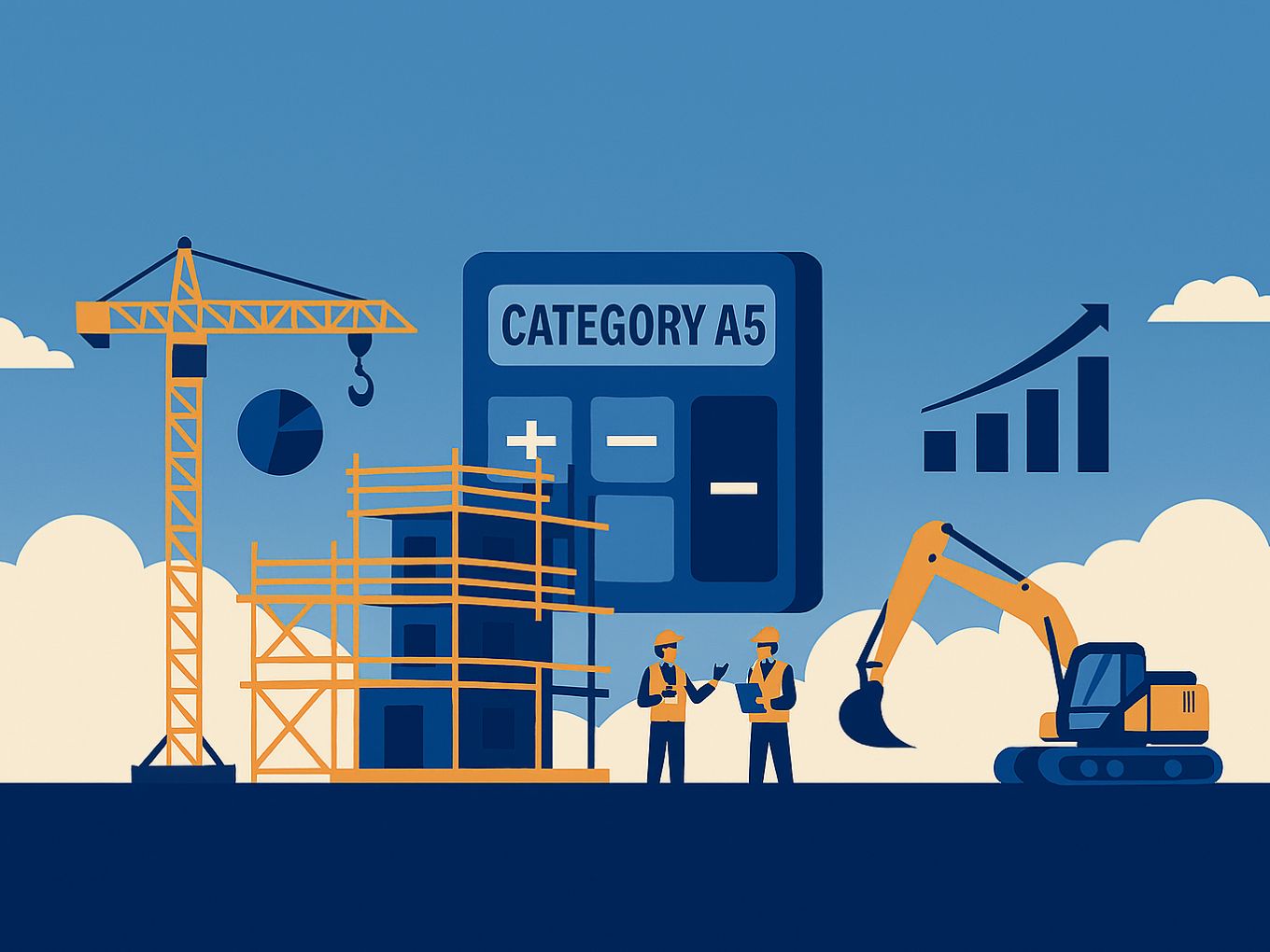
Category A5 Carbon Why it Matters More Than You Think
When we talk about carbon in construction, we’re really talking about whole‑life carbon — the total emissions from raw material extraction through to demolition. Standards such as the RICS Whole Life Carbon Assessment break this journey into modules (A1–C4), but one stage consistently slips under the radar: Category A5 — Construction and Installation.
A5 is where design meets reality. It captures the emissions that occur on site, and it’s also where temporary works often become a surprisingly large part of the carbon story.
What Category A5 Covers
Unlike A1–A4, which deal with material production and transport, A5 focuses on what happens once boots hit the ground. Key contributors include:
- Energy use on site — electricity, diesel, and fuel for machinery.
- Temporary works — scaffolding, shoring, propping, and protective structures.
- Waste generation — offcuts, packaging, surplus materials, and disposal.
- Site logistics — crane operations, deliveries, and internal material movement.
- Worker facilities — heating, lighting, and welfare units.
A5 may be smaller than material production, but it’s far from trivial. Construction‑stage emissions typically account for 5–10% of a project’s embodied carbon — enough to determine whether sustainability targets are met or missed.
And within A5, temporary works are often the hidden hotspot.
Temporary Works: Essential, But Carbon‑Heavy
Temporary works are fundamental to safety and sequencing. They stabilise retained façades, support altered load paths, and protect existing fabric during construction. But they come with their own carbon challenges:
- Material demand — steel props, timber formwork, and concrete bases all carry embodied carbon.
- Short lifespan — they’re dismantled once permanent works take over.
- Transport and logistics — repeated delivery, installation, and removal add emissions.
- Waste generation — formwork and protective materials often have limited reuse potential.
The paradox is clear: temporary works exist only to enable permanent works, yet their carbon footprint can sometimes erode the benefits of retaining existing structure.
This is where experienced structural judgement becomes essential — and where CBE’s expertise often makes the difference.
Balancing Retention and Temporary Works
Retaining existing fabric avoids demolition and reduces the need for new materials. But stabilising that fabric can require significant temporary interventions.
The key is to compare the carbon values:
- Carbon saved by retaining structure (avoided demolition + avoided new materials).
- Carbon spent on temporary works (materials, transport, energy, waste).
Retention should reduce whole‑life carbon — not increase it. This balance is especially critical on heritage and reuse projects, where the instinct to retain must be matched with rigorous carbon logic.
CBE’s role often sits right at this intersection: ensuring that structural strategy, sequencing, and temporary works design all align with the project’s sustainability intent.
Reducing A5 Emissions in Temporary Works
There are practical ways to minimise A5 impacts without compromising safety:
- Modular, reusable systems for scaffolding and shoring.
- Low‑carbon materials, such as engineered timber or recycled steel.
- Digital modelling to avoid over‑engineering.
- Lean sequencing to shorten the duration and scale of temporary works.
- On‑site renewables to power site operations.
These strategies work best when integrated early — ideally during structural concept design, not after the contractor arrives on site.
Final Thought
Whole‑life carbon assessment is about accountability across every stage of a building’s life. Category A5 ensures we don’t ignore the emissions that occur when a project actually comes to life. Temporary works are essential, but they’re also a carbon cost that must be understood, quantified, and managed.
With the right structural strategy — and the right specialist advice — temporary works can shift from being a hidden carbon burden to a controlled, minimised necessity.