
Structural Retention and Building Reuse: Why Engineering Delivery Matters More Than Ever
The construction industry is undergoing a fundamental shift. Driven by sustainability targets, embodied carbon considerations and evolving planning policies, developers are increasingly being challenged to justify demolition and maximise the reuse of existing buildings. Across the UK, projects that would once have involved wholesale demolition are now focused on retention, adaptation and regeneration.
This transformation is creating new opportunities — but also new risks. Retaining an existing structure is often straightforward on a drawing. Delivering that retention safely, efficiently and commercially is where the real challenge begins.
The New Reality of Building Reuse
Many of today's most ambitious developments involve retaining significant elements of existing buildings while creating entirely new assets around them.
Historically, structural retention was often driven by heritage requirements. Façades, architectural features and historically significant structures were preserved because of their cultural value. The transformation of the former US Embassy into the Rosewood Hotel in Mayfair demonstrates the complexity of this approach. Retaining the existing façade and second-floor diagrid required a highly engineered solution that effectively involved constructing a new building beneath and around retained structural elements.
Today, however, retention is increasingly driven by sustainability. Developers and asset owners recognise that the most sustainable structure is often the one that already exists. Planning authorities are responding accordingly, placing greater emphasis on reuse and refurbishment as part of the drive to reduce embodied carbon.
As a result, more projects are seeking to retain façades, structural frames, basements and other significant elements. While these decisions can generate substantial environmental benefits, they also introduce significant engineering and construction challenges.
The Gap Between Design Intent and Construction Reality
The decision to retain part of a structure is often made during the planning and design stages. Once approved, that decision becomes embedded within the project.
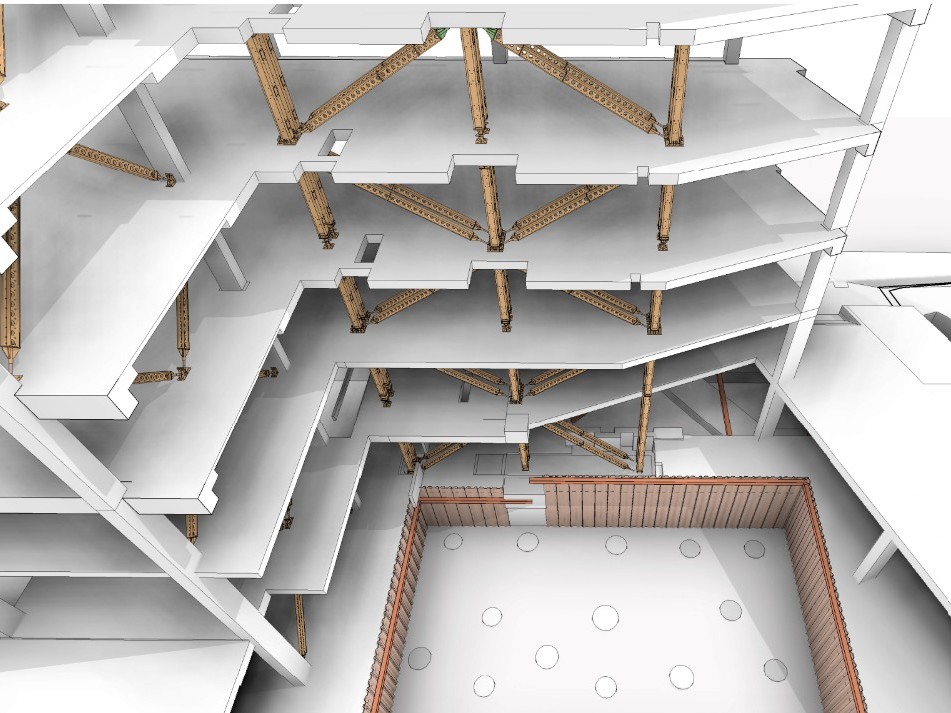
What is less visible is the complexity required to deliver it. Retained structures frequently require extensive temporary works to maintain stability while demolition, strengthening and new construction take place around them. New permanent works may be required to support retained elements, but these can often only be installed after sections of the existing building have been removed.
At the same time, contractors must contend with constrained city-centre sites, limited access, crane strategies, scaffolding, logistics routes, loading zones and programme constraints. Each decision affects another. Temporary works influence sequencing. Sequencing affects logistics. Logistics impact programme. Programme drives cost.
When these factors are considered independently, projects can quickly encounter unforeseen risks, delays and cost pressures. This is why the critical question is rarely whether a retention strategy is technically possible. The real question is whether it can be delivered.
Engineering Built Around Delivery
At Cambell Brown Engineers, we believe successful regeneration projects require more than structural analysis alone. They require engineering built around delivery.
This means understanding not only how a structure behaves in its final form, but how it behaves throughout every stage of demolition, strengthening, temporary works and construction. It means integrating structural engineering, demolition engineering, temporary works, logistics and programme into a single delivery strategy.
Most project risks emerge during the transition between the existing building and the completed development. By understanding that transition early, project teams can make informed decisions that improve buildability, reduce risk and provide greater certainty around programme and cost.
This approach allows engineering decisions to be tested against construction reality before work begins on site.
Construction-Stage Engineering in Practice
A clear example of this approach can be seen at 65 Gresham Street in the City of London.
The project involved the concurrent delivery of demolition, structural strengthening and new construction works, with additional floors being constructed while works progressed below. This strategy accelerated programme delivery and simplified aspects of construction, but it required detailed analysis of the structure at every stage of the works.
Success depended not only on understanding the completed structure, but also on understanding the sequence through which it would be transformed. By integrating construction-stage engineering, temporary works, sequencing and programme planning, the project team developed a coordinated strategy that supported safe, efficient and commercially viable delivery.
The Future of Structural Retention
As sustainability targets continue to drive the reuse of existing buildings, structural retention projects will become increasingly common — and increasingly complex. The industry's focus is shifting from demolition alone to transformation.
Success will depend on understanding how existing structures can be adapted, strengthened and repurposed while managing the engineering and construction challenges that arise along the way.
For developers, contractors and design teams, the greatest value comes from engineering that provides certainty. Not simply certainty that a structure can stand, but certainty that a project can be delivered safely, efficiently and commercially.
That is where the future of demolition engineering lies. Not in what we remove. But in what we make possible.
Need support with a structural retention, demolition or building reuse project?
Cambell Brown Engineers specialise in engineering delivery for complex transformation projects, integrating structural engineering, demolition engineering, temporary works, sequencing and logistics to help project teams turn ambitious designs into buildable outcomes.